Hide targets for this goal
17.1 MOBILIZE RESOURCES TO IMPROVE DOMESTIC REVENUE COLLECTION

Strengthen domestic resource mobilization, including through international support to developing countries, to improve domestic capacity for tax and other revenue collection
17.2 IMPLEMENT ALL DEVELOPMENT ASSISTANCE COMMITMENTS

Developed countries to implement fully their official development assistance commitments, including the commitment by many developed countries to achieve the target of 0.7 per cent of ODA/GNI to developing countries and 0.15 to 0.20 per cent of ODA/GNI to least developed countries; ODA providers are encouraged to consider setting a target to provide at least 0.20 per cent of ODA/GNI to least developed countries
17.3 MOBILIZE FINANCIAL RESOURCES FOR DEVELOPING COUNTRIES

Mobilize additional financial resources for developing countries from multiple sources
17.4 ASSIST DEVELOPING COUNTRIES IN ATTAINING DEBT SUSTAINABILITY

Assist developing countries in attaining long-term debt sustainability through coordinated policies aimed at fostering debt financing, debt relief and debt restructuring, as appropriate, and address the external debt of highly indebted poor countries to reduce debt distress
17.5 INVEST IN LEAST DEVELOPED COUNTRIES

Adopt and implement investment promotion regimes for least developed countries
17.6 KNOWLEDGE SHARING AND COOPERATION FOR ACCESS TO SCIENCE, TECHNOLOGY AND INNOVATION

Enhance North-South, South-South and triangular regional and international cooperation on and access to science, technology and innovation and enhance knowledge sharing on mutually agreed terms, including through improved coordination among existing mechanisms, in particular at the United Nations level, and through a global technology facilitation mechanism
17.7 PROMOTE SUSTAINABLE TECHNOLOGIES TO DEVELOPING COUNTRIES

Promote the development, transfer, dissemination and diffusion of environmentally sound technologies to developing countries on favourable terms, including on concessional and preferential terms, as mutually agreed
17.8 STRENGTHEN THE SCIENCE, TECHNOLOGY AND INNOVATION CAPACITY FOR LEAST DEVELOPED COUNTRIES

Fully operationalize the technology bank and science, technology and innovation capacity-building mechanism for least developed countries by 2017 and enhance the use of enabling technology, in particular information and communications technology
17.9 ENHANCE SDG CAPACITY IN DEVELOPING COUNTRIES

Enhance international support for implementing effective and targeted capacity-building in developing countries to support national plans to implement all the sustainable development goals, including through North-South, South-South and triangular cooperation
17.10 PROMOTE A UNIVERSAL TRADING SYSTEM UNDER THE WTO

Promote a universal, rules-based, open, non-discriminatory and equitable multilateral trading system under the World Trade Organization, including through the conclusion of negotiations under its Doha Development Agenda
17.11 INCREASE THE EXPORTS OF DEVELOPING COUNTRIES

Significantly increase the exports of developing countries, in particular with a view to doubling the least developed countries’ share of global exports by 2020
17.12 REMOVE TRADE BARRIERS FOR LEAST DEVELOPED COUNTRIES

Realize timely implementation of duty-free and quota-free market access on a lasting basis for all least developed countries, consistent with World Trade Organization decisions, including by ensuring that preferential rules of origin applicable to imports from least developed countries are transparent and simple, and contribute to facilitating market access
17.13 ENHANCE GLOBAL MACROECONOMIC STABILITY

Enhance global macroeconomic stability, including through policy coordination and policy coherence
17.14 ENHANCE POLICY COHERENCE FOR SUSTAINABLE DEVELOPMENT

Enhance policy coherence for sustainable development
17.15 RESPECT NATIONAL LEADERSHIP TO IMPLEMENT POLICIES FOR THE SUSTAINABLE DEVELOPMENT GOALS

Respect each country’s policy space and leadership to establish and implement policies for poverty eradication and sustainable development
17.16 ENHANCE THE GLOBAL PARTNERSHIP FOR SUSTAINABLE DEVELOPMENT

Enhance the global partnership for sustainable development, complemented by multi-stakeholder partnerships that mobilize and share knowledge, expertise, technology and financial resources, to support the achievement of the sustainable development goals in all countries, in particular developing countries
17.17 ENCOURAGE EFFECTIVE PARTNERSHIPS

Encourage and promote effective public, public-private and civil society partnerships, building on the experience and resourcing strategies of partnerships
17.18 ENHANCE AVAILABILITY OF RELIABLE DATA

By 2020, enhance capacity-building support to developing countries, including for least developed countries and small island developing States, to increase significantly the availability of high-quality, timely and reliable data disaggregated by income, gender, age, race, ethnicity, migratory status, disability, geographic location and other characteristics relevant in national contexts
17.19 FURTHER DEVELOP MEASUREMENTS OF PROGRESS

By 2030, build on existing initiatives to develop measurements of progress on sustainable development that complement gross domestic product, and support statistical capacity-building in developing countries
Related Publications


Related Events
Past Event

LCS-RNet Meetings
LCS-RNet 15th Annual Meeting How can we accelerate action to stay below 1.5 degrees C?
On 19-20 December, the Leveraging a Climate-neutral Society Strategic Research Network (LCS-RNet) will hold its 15th Annual Meeting online. Under the main theme "How can we accelerate action to stay below 1.5 degrees C?", this annual meeting will...
Past Event

COP29 Japan Pavilion Side Event
For the Enhancement of the Implementation of Article 6 through Synergy of Capacity-Building and Private Investment
The event entitled “For the Enhancement of the Implementation of Article 6 through Synergy of Capacity-Building and Private Investment” was held at the COP29 Japan Pavilion in Baku, Azerbaijan on 18 November, 2024. At this seminar, Minister Asao...
Past Event

COP29 Japan Pavilion Side Event
Net-Zero and NDCs: Science-based Climate Policymaking And Implementation in Asia
The Paris Agreement states that all parties should strive to formulate and communicate long-term low greenhouse gas (GHG) emission development strategies. In addition, the outcome document on the first Global Stocktake at COP28 in 2023 indicates...
Related News
Announcement
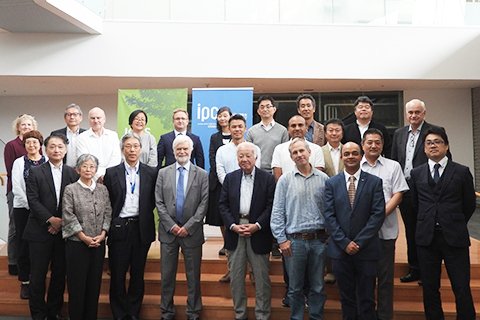
IPCC Chair Jim Skea Visits IGES for an Exchange of Views with Researchers
On Tuesday, 22 October, Professor Sir Jim Skea, Chair of the Intergovernmental Panel on Climate Change (IPCC) and Professor at Imperial College London, visited IGES's headquarters in Hayama and exchanged views with IGES researchers. Since 1999, IGES...
Announcement

Dr. Johan Rockström Visits IGES and Delivers Special Lecture
On 9 October, Dr. Johan Rockström, the globally renowned scientist on planetary sustainability and leading researcher on planetary boundaries (Director of the Potsdam Institute for Climate Impact Research and Professor in Earth System Science at the...
Announcement
Six ASEAN partners selected for ‘Breaking the Plastic Habit in Asia’ project (Phase II)
Tokyo/Jakarta 20 September 2024 IGES and the Regional Knowledge Centre for Marine Plastic Debris of ERIA (the Economic Research Institute for ASEAN and East Asia) have announced the launch of Phase II of the ‘Breaking the Plastic Habit in Asia’...
Related Projects
Project
Updated: December 2024
G20 (2024) Special webpage
Led by the Brazilian Presidency, the G20 Summit in 2024 is due to be held on 18-19 November in Rio de Janeiro. The world is now facing simultaneous and interlinked crises of climate change, biodiversity loss, and pollution. Moreover, prolonged...
Project
Updated: December 2024
ASEAN SDGs Frontrunner Cities Programme (SDGs-FC)
ASEAN SDGs Frontrunner Cities The ASEAN SDGs Frontrunner Cities Programme (SDGs-FC) is an initiative under the ASEAN Working Group on Environmentally Sustainable Cities (AWGESC) funded by the Japan-ASEAN Integration Fund (JAIF). It aims to support...
Project
Updated: December 2024
IGES and Climate Security: Asia-Pacific Climate Security Project
The climate security featured page will share research findings and related information on climate security. We are exploring various topics, including international trends analysis, energy security, food security, climate-induced human mobility, cl