Results 1 - 10 of 71 (Sorted by date)
Presentation
EANET / IIASA International Workshop
Author:
Tashi
Wangmo
Behnam
Zakari
Peter
Rafaj
Louise
Guibrunet
Shonali
Pachauri
Zbigniew
Klimont
Volker
Krey
Keywan
Riahi
This presentation was a part of MOEJ-IIASA collaboration project B (Bhutan case study), which focused on the alternative scenario analysis (SSP1 and SSP2) for the transition of energy-food-water and health nexus solutions in Bhutan.

Training or Learning Material
Author:
This lecture was given to the training programme on “Teaching Sustainability and Localising the Sustainable Development Goals in the Hindu Kush Himalaya”, 13 December 2022, online. The training programme was organized by the International Centre for Integrated Mountain Development (ICIMOD), Himalayan University Consortium (HUC), and Potsdam...
Issue Brief
The economic disruptions from the Ukraine war have intensified short term concerns about energy and food security, as well as access to critical minerals. Climate security is also increasingly urgent. This paper urges governments to speed up, not slow down, transitions away from fossil fuels and toward more sustainable development patterns. The war...
Commentary (Op. Ed)
IISD SDG Knowledge Hub
Author:
Yizhao
Yang
Marco
Reggiani
Anne
Taufen
Amidst ongoing conversations surrounding the attainment of net-zero emissions, it is crucial to underscore the importance of aligning substantive climate action with overarching sustainability objectives. The Voluntary Local Reviews (VLR) movement is gaining momentum, presenting an opportunity to extend its influence in fostering sustainable...
Keywords:
Conference Paper
TT12 Session, 2022 International Forum for Sustainable Asia and the Pacific (ISAP)
Author:
In 2022, UNEP conducted a regional review of the Voluntary National Reviews (VNR) in Asia-Pacific covering 36 countries and 50 VNRs from an environmental perspective. For indicators, we developed a framework to review the environment-related indicators and data that were used in the VNRs. We found that t he overall coverage of the environment...
Non Peer-reviewed Article
In IATSS Review
The transport sector is one of the main sources of global GHG emissions, of which road transport emissions are greatest. The decarbonisation of road transport requires systemic changes combined with technological interventions to optimise the use of transport modes. Given the diverse options for road transport decarbonisation due to differences in...
Policy Report
Open waste burning is a widespread practice that is provoked by a lack of systematic waste collection, the unavailability of other disposal options, and inadequate land for the final disposal of the collected waste, especially in low- and middle-income countries. From a global perspective, two billion people have no waste collection at all, and the...
Conference Proceeding
Thematic Track 3: IGES Contributions to “Climate and SDGs Synergy” at the International Forum for Sustainable Asia and the Pacific (ISAP) 2022
Due to the overlapping nature of SDG and climate actions, a clearer understanding of the interlinkages is needed to integrate these two agendas. As these interlinkages are very specific to the local context, engaging with stakeholders can help design the integrated approach at the local level by considering the socio-economic and biophysical...
Peer-reviewed Article
In Environmental Science and Pollution Research
Author:
Jatan
Debnath
Dhrubajyoti
Sahariah
Durlov
Lahon
Nityaranjan
Nath
Kesar
Chand
Gowhar
Meraj
Majid
Farooq
Shruti
Kanga
Suraj Kumar
Singh
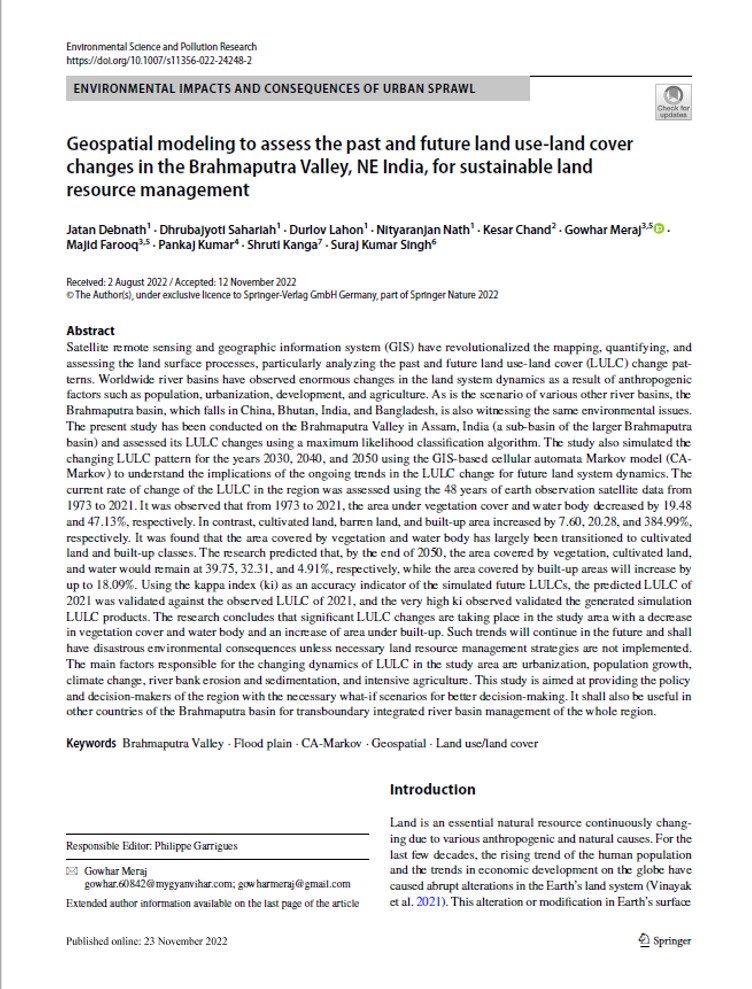
Satellite remote sensing and geographic information system (GIS) have revolutionalized the mapping, quantifying, and assessing the land surface processes, particularly analyzing the past and future land use-land cover (LULC) change patterns. Worldwide river basins have observed enormous changes in the land system dynamics as a result of...
Conference Proceeding
JSPS-ICSSR Seminar on Understanding and Addressing Systemic Risks Behind the Socio-economic Impacts of COVID-19 in Japan and India: Developing a Roadmap for a Resilient and Sustainable Future
The COVID-19 pandemic has reversed decades of progress in many developmental areas and aggravated the already-existing gaps in implementing Sustainable Development Goals (SDGs). Measures by countries to recover from the crisis have been varied. These measures, if designed properly and implemented efficiently, can stimulate progress in many pandemic...