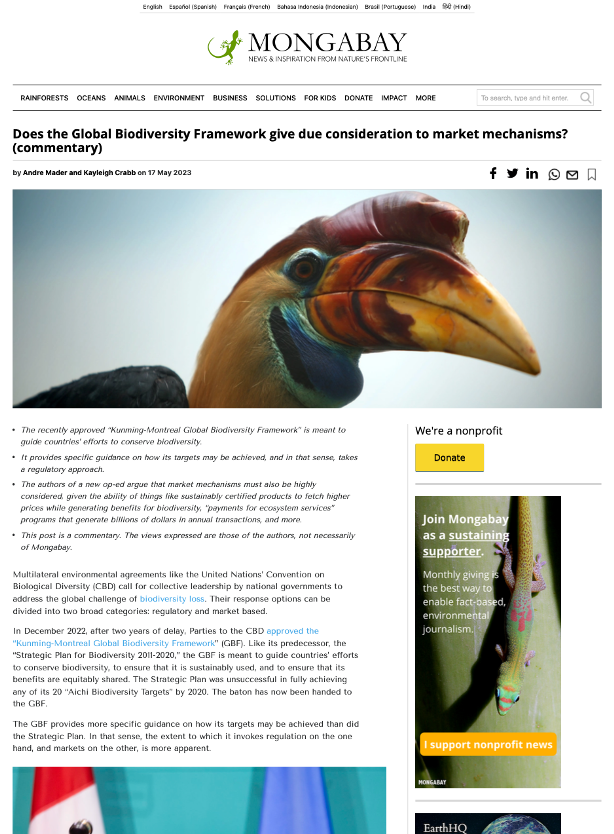
An opinion piece about the degree to which the Kunming-Montreal Global Biodiversity Framework invokes market-based as opposed to regulatory mechanisms.
The world's major investors, banks and other financial institutions are taking note of the upcoming 26 th meeting of the Conference of the Parties (COP26) to the United Nations Framework Convention on Climate Change (UNFCCC) to be held in November 2021, and they are committing to take actions in line with the Paris Agreement on Net Zero. At the...
The Sustainable Development Goals (SDGs) have recently framed sustainable development priorities in both developed and developing countries. External funding in the form of foreign direct investment (FDI) and official development assistance (ODA) is necessary for achieving practically all of the SDGs and their underlying targets. However, it is not...
A blog outlining how governments, especially in the G20, help the private sector to manage biological resources. Recommendations are based mostly on decisions by the Parties to the Convention on Biological Diversity.
Industry, in the context of this chapter, is mostly confined to the strict definition of the word: -“economic activity concerned with the processing of raw materials and manufacture of goods in factories”. Industry has a major impact on nature and its biodi- versity in Asia and the Pacific, as it does elsewhere in the world. Industry impacts...
Developing countries must submit forest reference emission levels (FRELs) to the UNFCCC to receive incentives for REDD+ activities (e.g. reducing emissions from deforestation/forest degradation, sustainable management of forests, forest carbon stock conservation/enhancement). These FRELs are generated based on historical CO2 emissions in the land...
Soil moisture (SM) plays a key role in many environmental processes and has a high spatial and temporal variability. Collecting sample SM data through field surveys (e.g. for validation of remote sensing-derived products) can be very expensive and time consuming if a study area is large, and producing accurate SM maps from the sample point data is...
Accurate mapping of glaciers is important for management of water resources, studying glacier mass-balance, and monitoring glacier health. However, many glaciers are partially covered by debris of varying thicknesses, and these debris-covered glacier areas are difficult to clearly distinguish from the adjacent valley rock using optical remote...