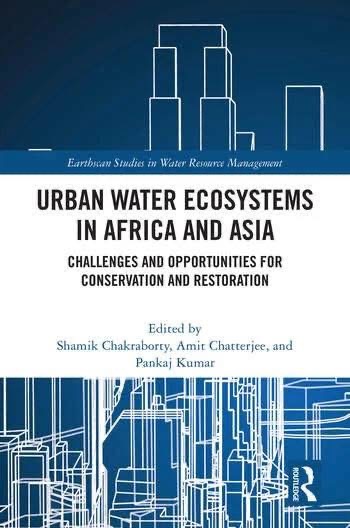
This book examines urban water ecosystem management and restoration through selected case studies in Asia and Africa. Employing a socioecological approach, this volume presents insights on the interlinkages between water, humans, and environmental conservation in an urban context. Topics include human health risks, population displacement and...
- Clear all
- Research Unit: (-) Adaptation & Water
- Region/Country: (-) Africa
Results 1 - 10 of 13 (Sorted by date)
In Climate
This study employs advanced geospatial analytical techniques to evaluate the vulnerability of Nigeria’s coastal states and their constituent local government areas to flood hazards, which represent a critical and escalating risk within the coastal hazard paradigm intensified by climate change phenomena. The study’s objective is to utilize...
In Anthropocene Science
While the global community has long worked to ameliorate the livelihoods of people and promote environmental sustainability around the world, many social, economic, and environmental issues remain unsolved. The Millennium Development Goals (MDGs) sought to end poverty but ended with mixed results depending on the country. The Sustainable...
In Current Research in Environmental Sustainability
The problem of water scarcity and clean water in sub-Saharan Africa is a growing concern. This study aims to quantify the water quality on a temporal scale in the Doorndraai dam site in sub-Saharan Africa to design possible management options. Here, an integrated approach using both in-situ measurements of water quality parameters and remote...
In Water
Considering the well‐documented impacts of land‐use change on water resources and the rapid land‐use conversions occurring throughout Africa, in this study, we conducted a spatiotemporal analysis of surface water quality and its relation with the land use and land cover (LULC) pattern in Mokopane, Limpopo province of South Africa. Various physico...
In Sustainability Challenges in Sub-Saharan Africa I: Continental Perspectives and Insights from Western and Central Africa
Droughts and floods are some of the major climatic hazards in the semi-arid areas of Sub-Saharan Africa (SSA). Climate change affects the periodicity and severity of such hazards, and eventually the well-being of many rural communities in the region, including semi-arid Ghana. Enhancing the resilience of local communities to droughts and floods...
In Geocarto International
Operational monitoring of vegetation and its response to climate change involves the use of vegetation indices (VIs) in relation to relevant climatic data. This study analyses the temporal variations of vegetation indices in response to climatic data (temperature and precipitation) to better understand the phenological changes in the Wa-West and...
In Water
Despite being a finite resource, both the quality and quantity of groundwater are under tremendous pressure due to rapid global changes, viz. population growth, land-use/land-cover changes (LULC), and climate change. The 6th Sustainable Development Goal (SDG) aims to “Ensure availability and sustainable management of water and sanitation for all”...
In Remote Sensing
To classify Very-High-Resolution (VHR) imagery, Geographic Object Based Image Analysis (GEOBIA) is the most popular method used to produce high quality Land-Use/Land-Cover maps. A crucial step in GEOBIA is the appropriate parametrization of the segmentation algorithm prior to the classification. However, little effort has been made to automatically...
途上国の森林減少・劣化に由来する温室効果ガス排出の削減等(以下「REDD+」という。)は重要な気候変動対策であり、気候変動に関する国際連合枠組条約の第21回締約国会議(COP21)で合意された「パリ協定」にもその実施と支援を奨励することが明記されたところである。 REDD+の推進には、途上国に対する資金と技術の提供が必要とされているが、公的資金には限界があることから、今後、REDD+の取組みを拡大していくには、民間セクターからの資金や技術の提供が鍵となる。しかしながら、民間セクターがREDD+に対して投資するには、排出削減クレジットが獲得できる等のインセンティブが必要(①)とされる。また、途上国がREDD+を実施するには、COP決定を踏まえつつ、各々の国情に応じた排出削減量の算定...