Though the worst of COVID-19 appears to be over, it also raises important questions about COVID-19's immediate and then longer-term impacts on urban air quality. To understand both sets of impacts, the United Nations Environment Programme (UNEP) Asia Pacific Office, the Institute for Global Environmental Strategies (IGES), the Ministry of...
- Clear all
- Publication Year: (-) 2023
- Research Unit: (-) Integrated Sustainability Centre
Results 1 - 10 of 58 (Sorted by date)
China has long sought to address climate change in line with other development goals. However, research supporting this alignment often employs data-driven models that downplay the policies and institutions needed to achieve the multiple benefits that studies feature in their analyses. This oversight is troubling because it neglects gaps between...
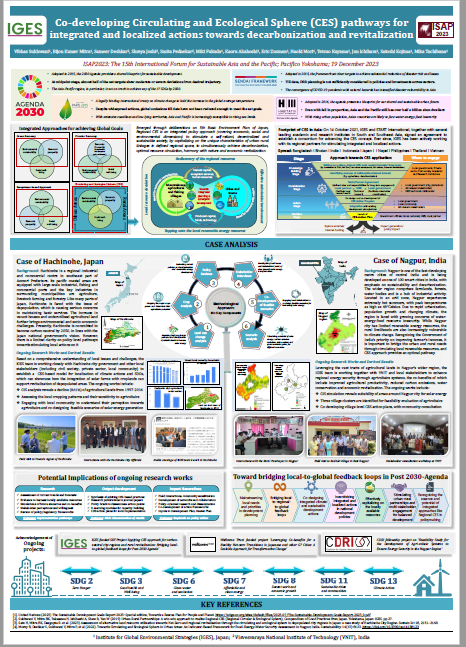
The 15th International Forum for Sustainable Asia and the Pacific
Considering the current shortfalls in timely realization of the targets set as per the UN-2030 Agenda, there is a genuine need for new approaches to integrate diverse policies and actions, in order to realize a more liveable, just and ecologically sustainable future. Correspondingly, CES has recently emerged as an integrated approach for...
IGES and Asia-Pacific Network for Global Change Research (APN) conducted the Regional-CES Scoping Project to assess the potential of promoting the Regional-CES concept in Asia. The scoping project organised workshops to engage key national and local stakeholders in the Philippines, Thailand and Indonesia in order to promote the Regional-CES concept...
In Reducing Emissions of Short-Lived Climate Pollutants Perspectives on Law and Governance
This chapter aims to bring policy and institutional considerations to the center of work on Short-Lived Climate Pollutants (SLCPs). Its primary purpose is to suggest policy and institutional reforms needed for an integrated and inclusive slcp strategy in Asia. The chapter begins by setting the context with a review of the interrelated yet varying...
Integrated Assessment Modeling Consortium (IAMC)
Bhutan is already facing significant impacts of climate change due to its mountainous and glacial terrain. The 1.5-degree scenario is a tipping point for glacial melting and water stability in Bhutan. It is therefore absolutely crucial to develop alternative options to deal with any catastrophic situation. The results of this research demonstrate...
In Earth System Governance
Mini-lateral ‘clubs’ occupy an increasingly prominent place in the international environmental governance landscape. Yet few studies have looked at how differences between clubs influence the results they produce. This paper aims to fill this gap in understanding by testing hypotheses on how different clubs’ membership constellations and leadership...
Integrated Assessment Modeling Consortium (IAMC)
This is a case study for formulating a comprehensive climate action plan for Da Nang City, Vietnam. As a joint effort, an international research team, Da Nang City, and Vietnam Institute of Meteorology, Hydrology and Climate Change worked together on developing a Climate Action Plan for Da Nang City. This plan is made up of seven key sectors...
In Environment and Urbanization ASIA
This study evaluates the gaps between urban and rural linkages within the corridor of Hoi An city and suggests potential solutions utilizing the circulating and ecological sphere principles for further strengthening these linkages and gradually promoting sustainable development of the city and surrounding area. A face-to-face interview method and...
In Hydrogen in Decarbonization Strategies in Asia and the Pacific
This chapter explores the interest in hydrogen adoption across Asian countries for achieving net-zero goals, with a particular focus on Japan's prominent role. While Japan has taken strides in hydrogen initiatives, the extent to which its strategy aligns with ambitious climate targets remains uncertain. The chapter emphasises the importance of...
Keywords: