Results 1 - 10 of 113 (Sorted by date)
Peer-reviewed Article
In Microplastics
Author:
Mahagama Gedara Yohan Lasantha Mahagamage
Sachith Gihan Gamage
Rathnayake Mudiyanselage Shehan Kaushalya Rathnayake
Thejani Abeynayaka
Chathura Welivitiya
Lahiru Udumalagala
Chathura Rajitha
Supun Suranjith
Synthetic fibers are widely used in daily life due to their durability, elasticity, low cost, and ease of use. The textile industry is the primary source of synthetic microfibers, as these materials are mostly used in production processes. Globally, plastic pollution has been identified as a major environmental threat in this era, since plastics...
Peer-reviewed Article
In Sustainability MDPI
Author:
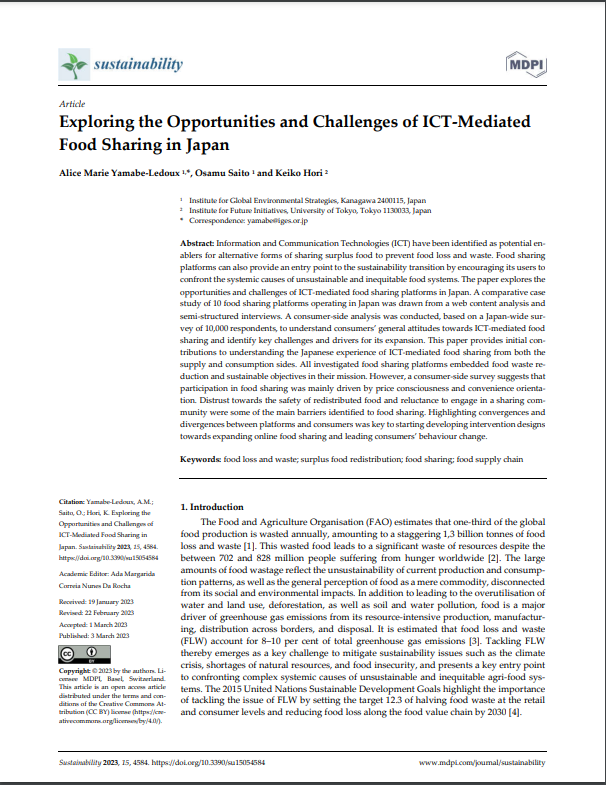
Information and Communication Technologies (ICT) have been identified as potential enablers for alternative forms of sharing surplus food to prevent food loss and waste. Food sharing platforms can also provide an entry point to the sustainability transition by encouraging its users to confront the systemic causes of unsustainable and inequitable...
Data or Tool
The IGES NDC Database compiles the main features of the Nationally Determined Contributions (NDCs), which were communicated by the Parties to the United Nations Framework Convention on Climate Change (UNFCCC) in order to present the targets and measures that will be taken in order to implement the Paris Agreement, according to countries’ national...
Book Chapter
In Aligning Climate Change and Sustainable Development Policies in Asia
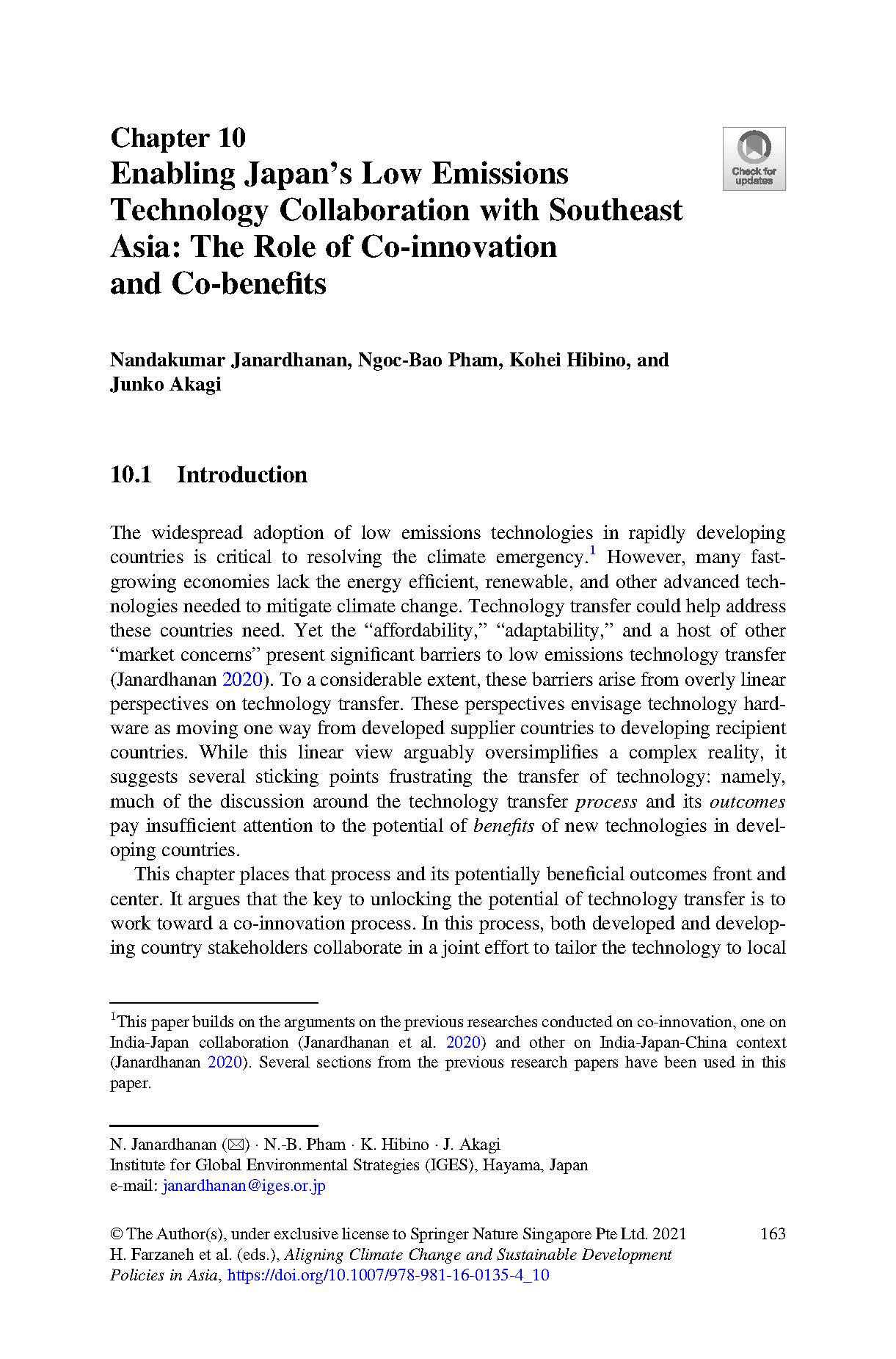
The widespread adoption of low emissions technologies in rapidly developing countries is critical to resolving the climate emergency.1 However, many fast growing economies lack the energy efficient, renewable, and other advanced technologies needed to mitigate climate change. Technology transfer could help address these countries need. Yet the...
Working Paper
Enhanced collaboration with countries with advanced technologies is essential to closing greenhouse gas (GHG) mitigation gaps in developing countries’ energy consuming and producing sectors. However, traditional models of technology transfer tend to focus on the sale of expensive technologies to developing countries, often subsidised through aid or...
Keywords:
Submission to Policy Process
According to the World Bank (2018), global annual waste generation is expected to jump from 2.01billion tonnes in 2016 to 3.40 billion tonnes over the next 30 years, and this trend is especially true in developing countries in Asia and Africa. This suggests that there has been very little success in reversing the trend of the increased generation...
Policy Report
Negombo City is one of the fastest growing tourist destinations in Sri Lanka. It is the major commercial and transport centre, and main health service provider for the region. However, municipal solid waste management is a pressing concern for Negombo due to expanding urbanization, increasing income, lack of public awareness, changes in consumption...
Report Chapter
In Global Environment Outlook 6 For Industry in Asia-Pacific
Asia and the Pacific’s unrelenting industrial development has been a driving force in the economic growth of scores of countries in the region and beyond. This shift has led to greater prosperity, increased urbanization and sustained population growth. Yet as the region has become the “world’s factory”, it is increasingly realizing not only the...
Research Report
Author:
Nebojsa
Nakicenovic
Dirk
Messner
Caroline
Zimm
Geoff
Clarke
Johan
Rockström
Ana Paula
Aguiar
Benigna
Boza-Kiss
Lorenza
Campagnolo
Ilan
Chabay
David
Collste
Luis
Comolli
Luis
Gomez-Echeverri
Anne
Goujon
Arnulf
Grubler
Reiner
Jung
George
Kamiya
Elmar
Kriegler
Michael
Kuhn
Julia
Leininger
Charles
Martin-Shields
Beatriz
Mayor-Rodriguez
Jerry
Miller
Apollonia
Miola
Keywan
Riahi
Maria
Schewenius
Jörn
Schmidt
Kristina
Skierka
Odirilwe
Selomane
Uno
Svedin
Paul
Yillia
This report assesses all the positive potential benefits digitalization brings to sustainable development for all. It also highlights the potential negative impacts and challenges going forward, particularly for those impacted by the ‘digital divide’ that excludes primarily people left behind during the Industrial Revolution like the billion that...