Provide a useful abstract or description for your publication. This and the title are the main tools a reader has for selecting items of interest from publication lists. Please craft the content of this field carefully. Provide a useful abstract or description for your publication. This and the title are the main tools a reader has for selecting...
- Clear all
- Language: (-) English
- Language: (-) Indonesian
- Language: (-) Laothian
Results 1 - 10 of 5180 (Sorted by date)
In Technology in Society
With nearly 70 % of the global population expected to live in urban areas by 2050, cities will need to manage energy transitions to achieve ambitious carbon neutrality goals. As the current rate of decarbonization in cities is too slow to achieve these ambitious goals, feasible pathways toward deep decarbonization are becoming increasingly urgent...
The outcome of the first Global Stocktake (GST1), concluded at COP28, is expected to firmly inform countries’ next nationally determined contributions (NDCs), due in early 2025, so as to ensure that global efforts are on track to achieve the goals of the Paris Agreement. Taking Malaysia as a case study country, the objective of this study is to...
Keywords:
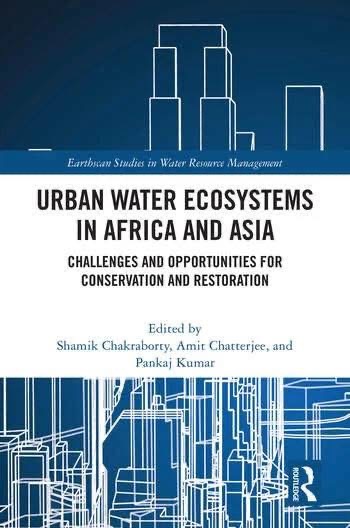
This book examines urban water ecosystem management and restoration through selected case studies in Asia and Africa. Employing a socioecological approach, this volume presents insights on the interlinkages between water, humans, and environmental conservation in an urban context. Topics include human health risks, population displacement and...
Historically, urban areas were built with the presence of freshwater ecosystems. It is well recognized that freshwater is a significant factor in urban growth and development, which supports the reciprocity of urban growth and water environments since historical times. Yet, what is not often realized is that freshwater is a subset of complex socio...
In Urban Water Ecosystems in Africa and Asia - Challenges and Opportunities for Conservation and Restoration
The idea of integrated water resource management (IWRM) for comprehensive and sustainable management of river and lake basins has been present in academia and policy-making for over half a century. Despite its presence in academia and policy-making for some time, IWRM has seen some major bottlenecks, such as a lack of comprehensive and holistic...
In Urban Water Ecosystems in Africa and Asia - Challenges and Opportunities for Conservation and Restoration
Japan is considered a water-rich country. Yet, recent socioecological history suggests that the country has undergone some drastic changes in its water environment as an extended effect of its post-war industrialization and urbanization. On the other hand, Japan also houses ingenious and time-tested methods of water management in its traditional...
In Urban Water Ecosystems in Africa and Asia - Challenges and Opportunities for Conservation and Restoration
Coastal cities in Vietnam are increasingly impacted by rapid environmental changes and the growing frequency and magnitude of hydrometeorological hazards, such as extreme precipitation and droughts. One of the most significant challenges posed by climate change is the imbalance of water resources availability between the wet and dry seasons. Both...
In Urban Water Ecosystems in Africa and Asia - Challenges and Opportunities for Conservation and Restoration
The present research focuses on estimating the impact/achievements of the long-term efforts of community afforestation programs on socio-ecological well-being in Africa with a case study from Kenya. An integrated approach (both qualitative and quantitative analysis, conducted through field and questionnaire surveys) was used in the Karura Forest...
In Urban Water Ecosystems in Africa and Asia - Challenges and Opportunities for Conservation and Restoration
This chapter focuses on the key arguments on urban water ecosystems and their management from the previous 14 chapters of this edited volume. Throughout the volume, we understand the complexity of urban water ecosystems and their effective management. Learning about these complexities can be taken as an advantage for navigating socioecological...